Guide · Food delivery app
Building a food delivery app: the Nibblify example
By Zakaryae Ait Ouamer, founder and lead developer of Nibblify Published 22 October 2026
In short
A food delivery app is really three apps: one for the customers who order, one for the restaurants that cook and one for the drivers who deliver. They share a backend that keeps orders, menus and statuses consistent everywhere, and the team uses an internal tool to verify restaurants and track orders. This is the architecture of Nibblify, a food ordering and delivery platform founded by Zakaryae Ait Ouamer, who developed its three Flutter apps, Nibblify Food, Partner and Driver, published on the App Store between January and September 2026 and available on Google Play, as well as their Firebase backend and the operations portal. This guide explains what to build, what matters in production, how publishing on the stores works and what it costs: from €16,900 excluding tax for a multi-app platform. As of 22 October 2026, Nibblify has not opened customer ordering yet.
- 3
- Flutter apps published: customers, restaurants, drivers
- 1
- Firebase backend shared by the three apps and the operations portal
- €16,900
- starting price excl. tax of the Multi-app platform package (not what Nibblify cost), typical timeline 4–6 months
Three audiences, three apps: who does what in an order?
A food order involves three people with different tasks and different screens. The customer looks for a dish, fills a basket, pays and tracks the delivery. The restaurant accepts the order, prepares it and keeps its menu, offers and opening hours up to date. The driver starts a shift, accepts a run, follows the route to the restaurant and then to the customer, and confirms the handover.
Putting all three roles in one app would force everyone through screens that are not theirs, and every update would affect everyone. Separate apps can fit their audience: according to the article “How We Built Nibblify”, the driver app is built to stay light on the low-end phones that drivers actually carry.
Nibblify follows this split, with one app per role on the App Store and Google Play. The three screens below follow the steps of an order.
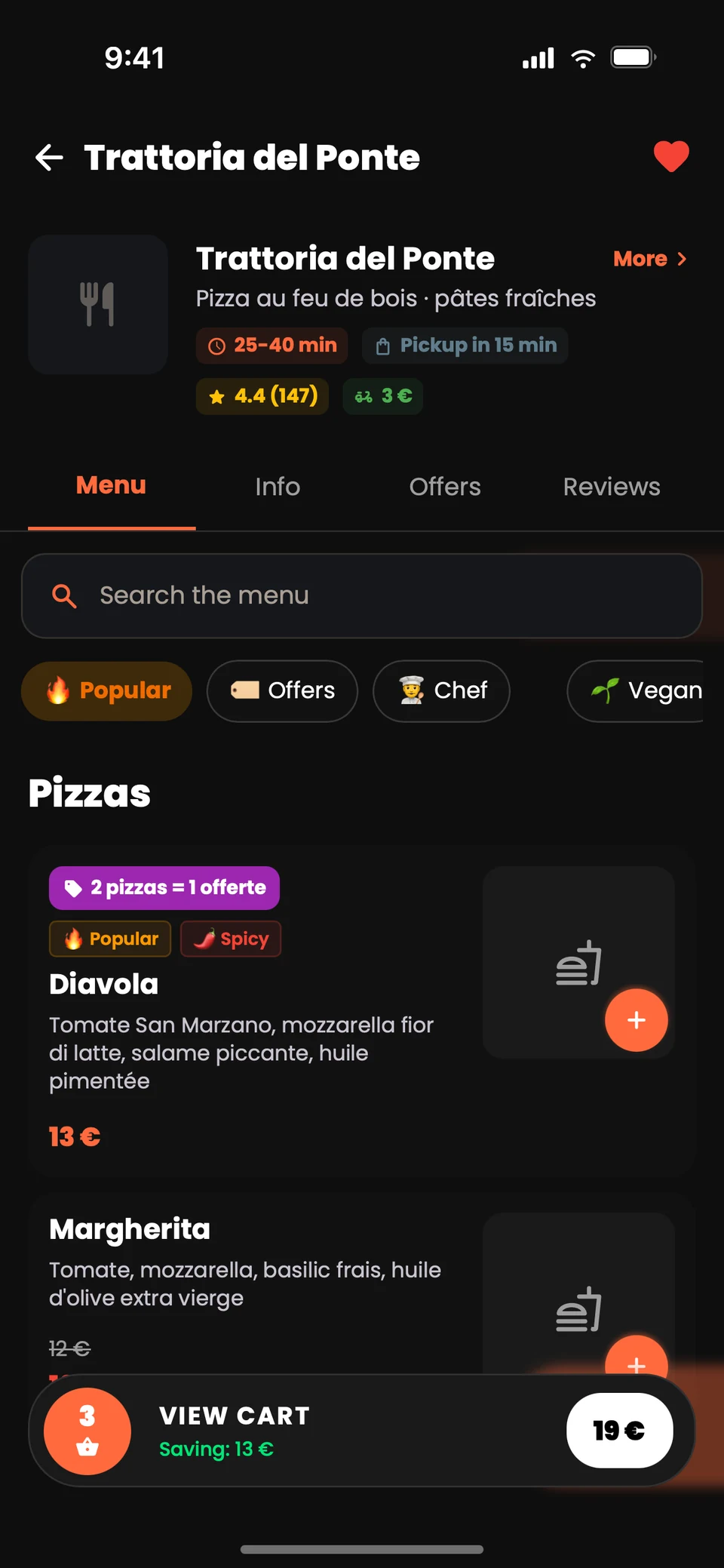
Step 1 · The customer orders
Nibblify Food
The customer browses a restaurant’s menu, filters dishes and fills the basket.
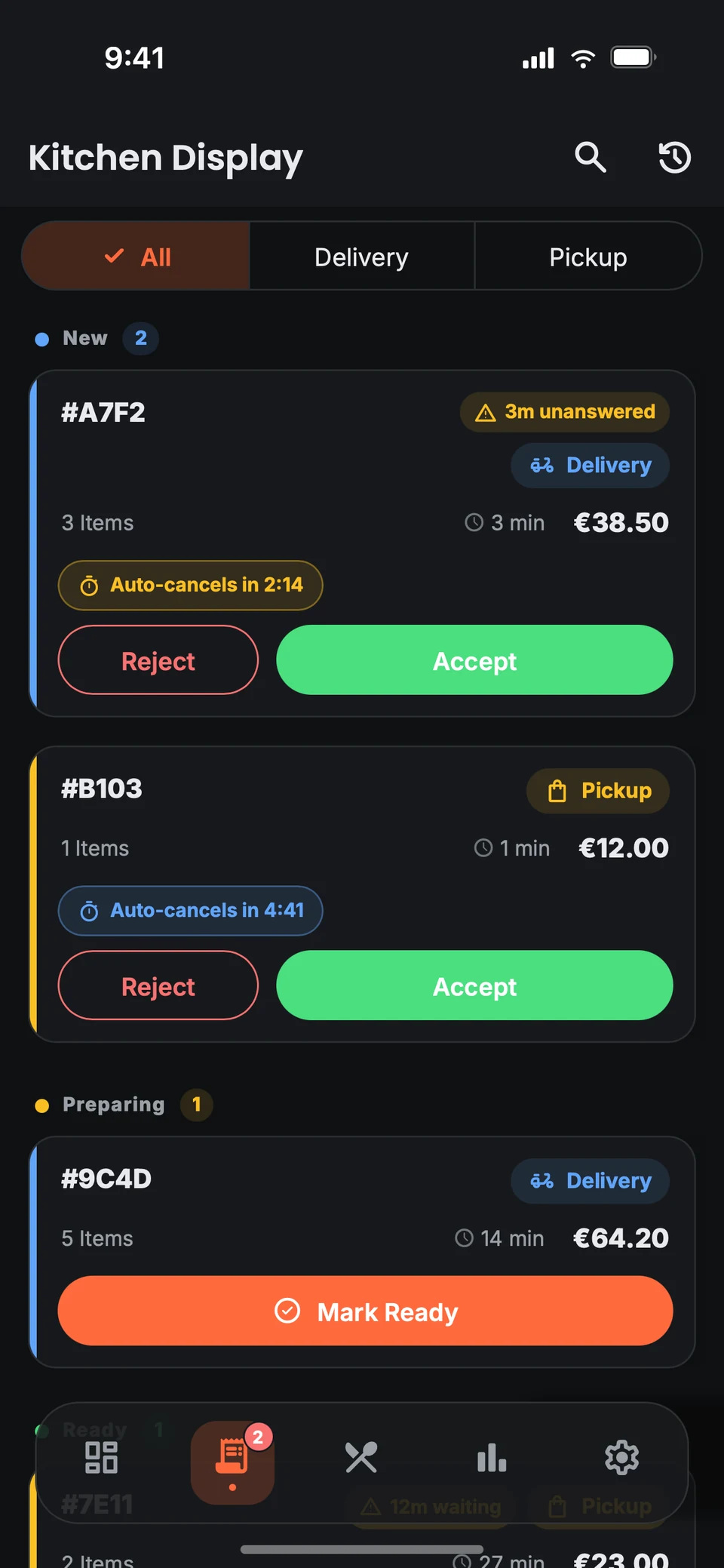
Step 2 · The restaurant prepares
Nibblify Partner
The kitchen display lists new orders to accept or reject, then orders in preparation to mark as ready.
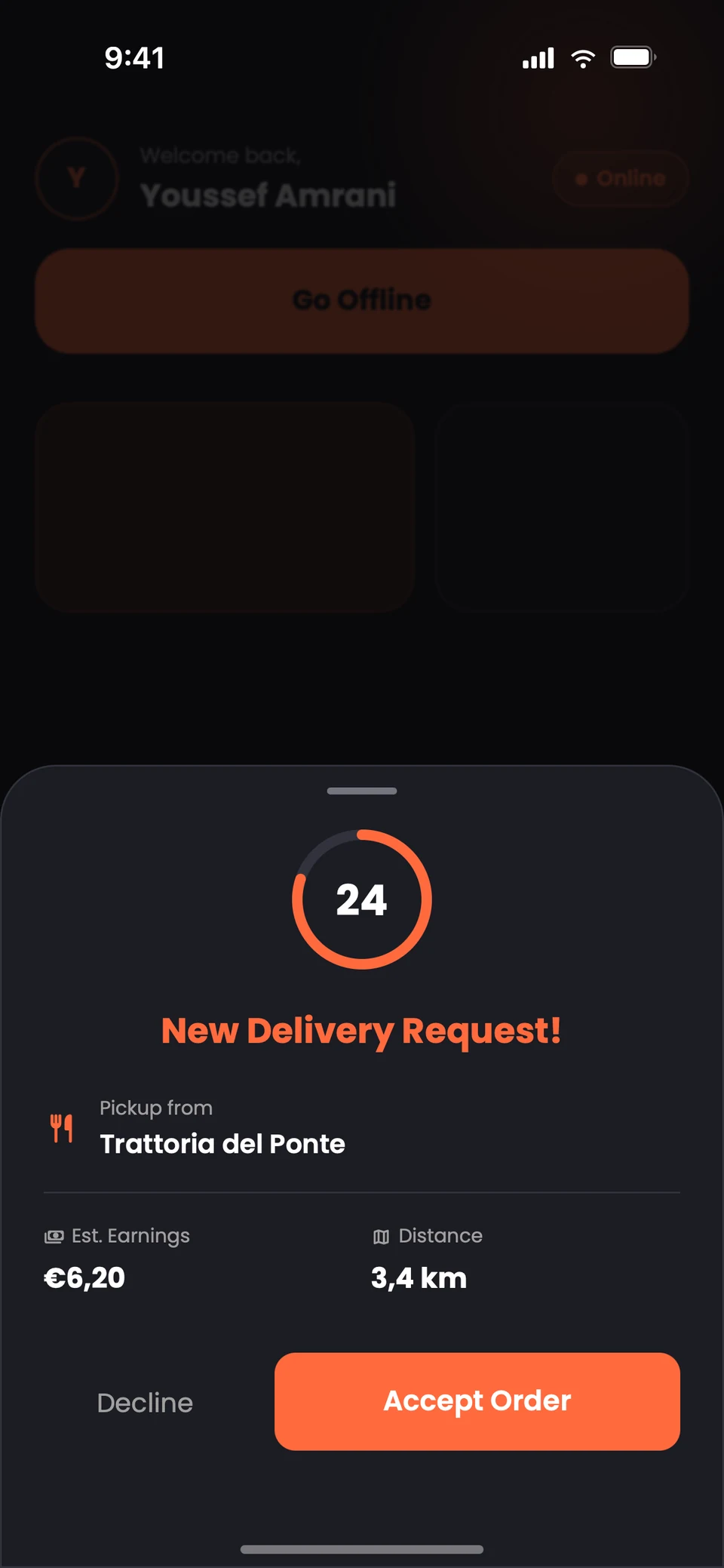
Step 3 · The driver delivers
Nibblify Driver
A delivery request shows the restaurant to collect from, the distance and the estimated earnings, with a countdown to accept it.
App visuals with demonstration data: the restaurants, amounts, distances and earnings shown are fictitious.
Zakaryae Ait Ouamer’s role, the technologies and the current status of the project are summarised in the Nibblify case study.
What does the backend of a food delivery app do?
The backend is the invisible part everything depends on: it signs users in, records orders, calculates amounts, assigns runs and notifies each person at the right time. At Nibblify, the three apps and the operations portal share a single Firebase backend. The article “How We Built Nibblify”, published on 5 August 2026, lists its services: Authentication, Firestore, Storage, Messaging, Remote Config, App Check, Crashlytics and Analytics. Hand-written security rules protect its 47 collections, 1,119 lines of rules in all: in the article’s words, the database is the contract between all four apps.
- Nibblify Food Customers
- Nibblify Partner Restaurants
- Nibblify Driver Drivers
- Operations portal Internal team · Flutter Web
Shared Firebase backend
- Authentication
- Firestore
- Storage
- Messaging
- Remote Config
- App Check
- Crashlytics
- Analytics
238 Cloud Functions
- orders
- payouts
- driver assignment
- personal data encryption
- data exports
- push notifications
- admin API
Sensitive decisions are made on the server
At Nibblify, the sensitive logic runs in 238 Cloud Functions written in JavaScript, about 25,500 lines according to the same article. They handle orders, payouts, driver assignment, AES-256 encryption of personal data, exports of that data on request, push notifications and the admin API. Google Maps provides location.
Why on the server? An app installed on a phone can be outdated, modified or offline, so a price, a run or a payout has to be decided in one place that every app consults. Privacy follows the same logic: according to the “About Nibblify” page, personal data is encrypted with AES-256 before it reaches the database.
The operations portal, the app customers never see
A delivery platform also needs work behind the scenes: verifying a restaurant before it goes live, checking drivers’ documents, helping a customer whose order went wrong. At Nibblify, these tasks run through an internal Flutter Web portal, separate from the consumer apps and absent from the stores.
The article “How We Built Nibblify” describes its scope: restaurant verification, driver documents and wallets, order support, live maps, analytics and monitoring, with 102 admin-only Cloud Functions behind it. At 49,900 lines of code, it is the second-largest of the four apps, after the customer app. The takeaway for your budget: the operations tool is not a last-minute extra, it is an app in its own right.
One Flutter codebase for iOS, Android and the web
According to the article “How We Built Nibblify”, all four apps share one language, Dart 3.10, and one UI toolkit, Flutter, with Riverpod, Provider and go_router, so iOS, Android and the web come out of a single codebase. In practice, each mobile app is written once and published on both stores, and the portal uses the same technology in the browser.
The table reproduces the line counts published in the article, measured on 2 August 2026, excluding dependencies and generated files. They show the relative size of each part, not a timeline or a cost.
| Part | Size |
|---|---|
| Nibblify Food Customers · Dart | 69,600 lines 269 files |
| Nibblify Partner Restaurants · Dart | 41,700 lines 140 files |
| Nibblify Driver Drivers · Dart | 11,600 lines 50 files |
| Operations portal Internal team · Flutter Web | 49,900 lines 191 files |
| Backend All apps · JavaScript, Cloud Functions | 25,500 lines 238 functions |
Across the whole platform, including parts not shown in the table, the article counts 307,000 hand-written lines, excluding generated files, by one person working with frontier AI models, a method it calls “vibe engineering”. Zakaryae Ait Ouamer sets the intent, the architecture and the data model; the models write the first drafts, which are read line by line; and the repository provides the proof, with 296 Dart test files, emulator-backed integration tests and security-rule tests.
Two details that matter in production
In production, a price can change while a customer hesitates, and the same dish can be spelled several ways. Nibblify handles both cases, and any food delivery app should plan for them.
The total confirmed is the total paid
Between opening the basket and confirming, a restaurant may change a price, or an offer may expire. If the app showed one total and the server computed another, the customer would pay an amount they never saw. At Nibblify, the basket summary and the order creation rely on the same calculation, and a guard compares the two totals: if they differ, the order is rejected rather than accepted at a price the customer did not confirm. Integration tests check that both paths reach the same total.
Search that handles accents and Arabic
If a customer types “creme brulee” without accents, or writes a dish in Arabic with a different letter form from the one on the menu, a naive search finds nothing. Nibblify’s search reduces queries and indexed content to one form, with Latin accents removed and a single spelling for Arabic letters that have several, then tolerates typos. For a service used in several languages, this belongs in the design of the index, not in a fix after the first empty searches.
Publishing three apps on two stores: dates, fees and lead times
Three apps on two stores means six listings to prepare, get reviewed and keep up to date. The Nibblify apps are published under the developer name “Zakaryae Ait Ouamer”, with one account per store, and are free. They reached the App Store one after another:
- 16 January 2026: Nibblify Partner, the restaurant app
- 9 March 2026: Nibblify Food, the customer app
- 8 September 2026: Nibblify Driver, the driver app
All three received an App Store update on 16 October 2026.
Store accounts are opened in your name, and one account can publish several apps, so three apps cost no more in store fees than one.
App Store
- Fees
- 99 USD per membership year of the Apple Developer Program
- Review and testing
- Every version goes through App Review. Apple says it typically reviews at least 50% of submissions in less than 24 hours and 90% in less than 48 hours.
Google Play
- Fees
- 25 USD once, when you register for Play Console
- Review and testing
- A personal account created after 13 November 2023 must first run a closed test for each app, with at least 12 testers opted in continuously for 14 days or more. Allow those two weeks per app if your account is personal and recent.
How much does a food delivery app cost, and how long does it take?
A delivery platform matches my Multi-app platform package: from €16,900 excluding tax, with a typical timeline of 4–6 months. It brings together the building blocks described in this guide:
Multi-app platform
Several connected apps around one backend: customers, partners, drivers and your operations team.
From €16,900 excl. tax
Typical timeline: 4–6 months
- 2 to 3 Flutter apps for iOS and Android
- Web operations portal (Flutter Web)
- Shared Firebase backend with Cloud Functions
- Real-time orders, maps and notifications
- Public website included
This is a starting price, excluding tax, valid until 31 December 2026; the written quote sets the final price according to the screens, roles and integrations. This price says nothing about what Nibblify cost to build, which is not published. Store accounts, hosting and Firebase usage are billed to you directly by their providers.
For a single app, with its add-ons and maintenance, see the guide to how much a mobile app costs.
What is not done yet
This guide is based on a published product, not on a service in operation. As of 22 October 2026:
- Nibblify has not opened customer ordering yet; its website says delivery in Le Mans, France, is being prepared.
- Nibblify signed a pre-incubation agreement with Le Mans Innovation on 4 August 2026, which remains in place while the launch is prepared.
- No usage figures are published: no order numbers, revenue or user counts.
- The screens shown here contain demonstration data.
- Behaviour under real load, with real customers and drivers, remains to be seen after launch.
What can be checked today: the three apps on the stores, their release dates and the architecture described by their developer.
Sources
Nibblify’s website: nibblifyfood.com/about and nibblifyfood.com/vibe-engineering (“How We Built Nibblify — Vibe Engineering”, by Zakaryae Ait Ouamer, published on 5 August 2026). The listings of the three apps on the App Store and Google Play. Apple’s official pages (Apple Developer Program, App Review) and Google’s (Play Console registration, testing requirements), checked on 21 October 2026.
Launching a food delivery platform?
Describe your project in a few lines: who orders, who cooks, who delivers, in which city and by when. You’ll hear back within 48 hours and, if it’s a fit, we’ll schedule a free scoping call by WhatsApp message.